
By GoAlcobaça Team●November 22, 2026
Stone, Silence and a Love Until the End of the World: The Complete Guide to Alcobaça Monastery
For almost nine centuries, Alcobaça Monastery has kept the memory of kings, monks and lovers. We walk through the church, the tombs of Pedro and Inês, the cloister of silence and the most famous kitchen in Portugal, with everything you need to plan your visit.
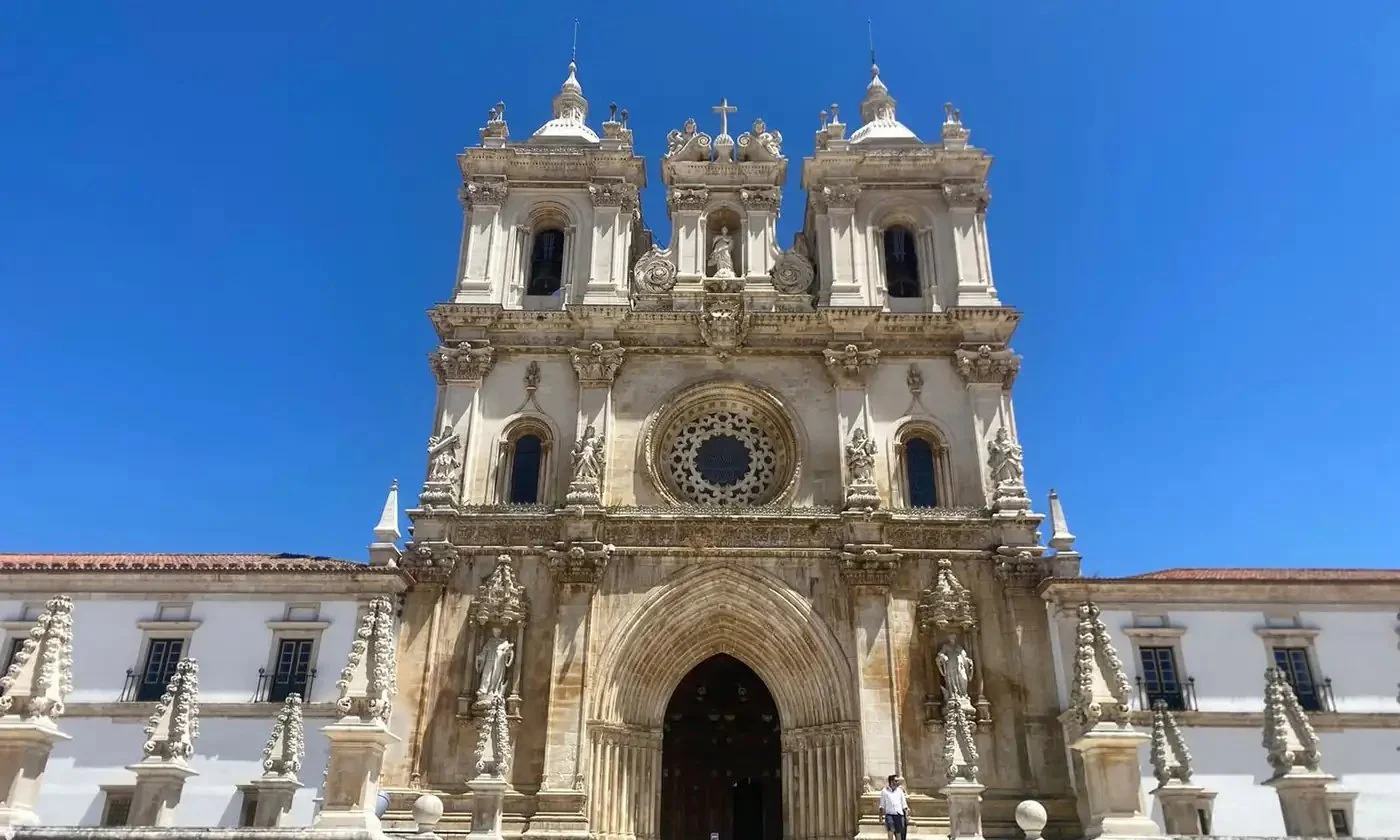
Alcobaça Monastery in 30 seconds
- What it is: the Cistercian abbey of Santa Maria de Alcobaça, founded in 1153 by King Afonso Henriques and a UNESCO World Heritage Site since 1989.
- Why go: the largest church in Portugal and the first in the Gothic style, the tombs of King Pedro and Inês de Castro, the Cloister of King Dinis and the monumental 18th-century kitchen.
- Opening hours: from 1 November to 31 March, 9am to 5:30pm (last entry 5pm). From 1 April to 31 October, 9am to 6:30pm (last entry 6pm).
- Ticket: €15 (standard ticket). Free for Portuguese citizens and residents of Portugal, up to 52 days a year (Acesso 52 scheme).
- Closed: 1 January, Easter Sunday, 1 May, 20 August and 25 December.
- Time needed: allow at least an hour and a half to two hours.
In this article
History The church Pedro and Inês The cloister The monks’ rooms The kitchen Hall of the Kings Monastic life How to visit FAQ
Anyone arriving in Alcobaça for the first time soon realises that the town grew up in the shadow of a single building. The monastery fills the centre of the landscape, its pale façade facing the great square, and everything around it seems designed to give it room. But the real surprise comes inside. The church opens into a nave of bare stone, immensely tall and silent, where white light pours through the windows onto columns that seem to go on forever. It is hard not to lower your voice.
The Monastery of Santa Maria de Alcobaça is many things at once. It is one of the first great monasteries of the Cistercian Order in Portugal, and the most important of them all. It is where King Pedro I and Inês de Castro, the protagonists of Portugal’s most famous love story, lie at rest. It is a lesson in architecture that runs from Gothic through Manueline to Baroque. And above all, it is a visit that asks for time. This guide takes you room by room, tells the stories the stones do not, and gathers all the practical information so that nothing is left unseen.
An abbey born with Portugal
The story of the monastery begins almost at the same time as the story of the country. In 1147, King Afonso Henriques captured Santarém and Lisbon and pushed the Christian frontier down to the line of the Tagus. Holding that territory meant settling it, farming it and organising it quickly, and few institutions did that as well as the religious orders. The founding charter of the abbey of Santa Maria de Alcobaça is dated 8 April 1153. With it, Portugal’s first king gave the lands of Alcobaça to Bernard of Clairvaux and the Cistercian Order.
Tradition tells the story in a more romantic way: Afonso Henriques is said to have promised these lands to Saint Bernard if he managed to take Santarém from the Moors, and to have kept his word after the victory. That version is told in tiles on the walls of the Hall of the Kings, which is still the first room many visitors see. Legend or not, the founding of Alcobaça was tied from the very beginning to the rise of the kingdom and to the protection of its kings.
The first monks settled in temporary quarters, later known as the old monastery. Only in 1178 were they ready to begin the great abbey we know today. Work went on for decades: in 1223 the monks moved into the new buildings, by then essentially complete, and in 1252 the church was dedicated, although work continued for some time afterwards. In 1269 a public school opened at the monastery, and in the 13th and 14th centuries several kings and queens chose Alcobaça as their burial place.
In the Middle Ages, Alcobaça became one of the richest and most powerful abbeys in the Iberian Peninsula. The white monks, as the Cistercians were known because of their pale habits, ran a vast territory, the so-called coutos of Alcobaça, where they cleared fields, drained wetlands, planted orchards and founded farms. Many of the region’s villages were born or grew under their administration. São Martinho do Porto, for example, first appears in a document of 1257 signed by Friar Estêvão Martins, the 12th abbot of the monastery, and for centuries served as the abbey’s seaport.
The town’s very name preserves the geography that drew the monks here. The monastery stands near the meeting point of two rivers, the Alcoa and the Baça, and it was from the joining of the two names that Alcobaça was born. The water of these rivers turned mills, irrigated vegetable gardens and even ran, through a purpose-built channel, right into the monks’ kitchen.

From the Middle Ages to the 19th century
The monastery never stopped growing. Between the 16th and 18th centuries, new cloisters, wings, chapels and an entirely new façade were added to the medieval buildings. Under King Manuel I, the upper storey of the cloister and a new Manueline sacristy were built. Between the 17th century and the mid-18th century came the Cardinal’s Cloister and the Rachadoiro Cloister, also called the Library Cloister. The 18th century brought the famous kitchen and gave the façade the Baroque look we see from the square today.
The 19th century was less kind. The French invasions left their mark on the monastery, and in 1833, during the civil war, the monks abandoned the abbey. The following year, the dissolution of the religious orders ended almost seven centuries of Cistercian presence. The building passed to the State, was divided up and put to very different uses, and only in the 20th century did the long restoration begin that gave it back its dignity. Of the old library, once one of the most important in the country, hundreds of medieval manuscripts survive and are now kept at the National Library of Portugal in Lisbon.
In 1907 the monastery was classified as a national monument and, in 1989, it was added to the UNESCO World Heritage List. UNESCO describes it as a masterpiece of Cistercian Gothic art, thanks to the scale of its dimensions, the purity of its style, the beauty of its materials and the care with which it was built.
The church: Portugal’s largest and first Gothic church
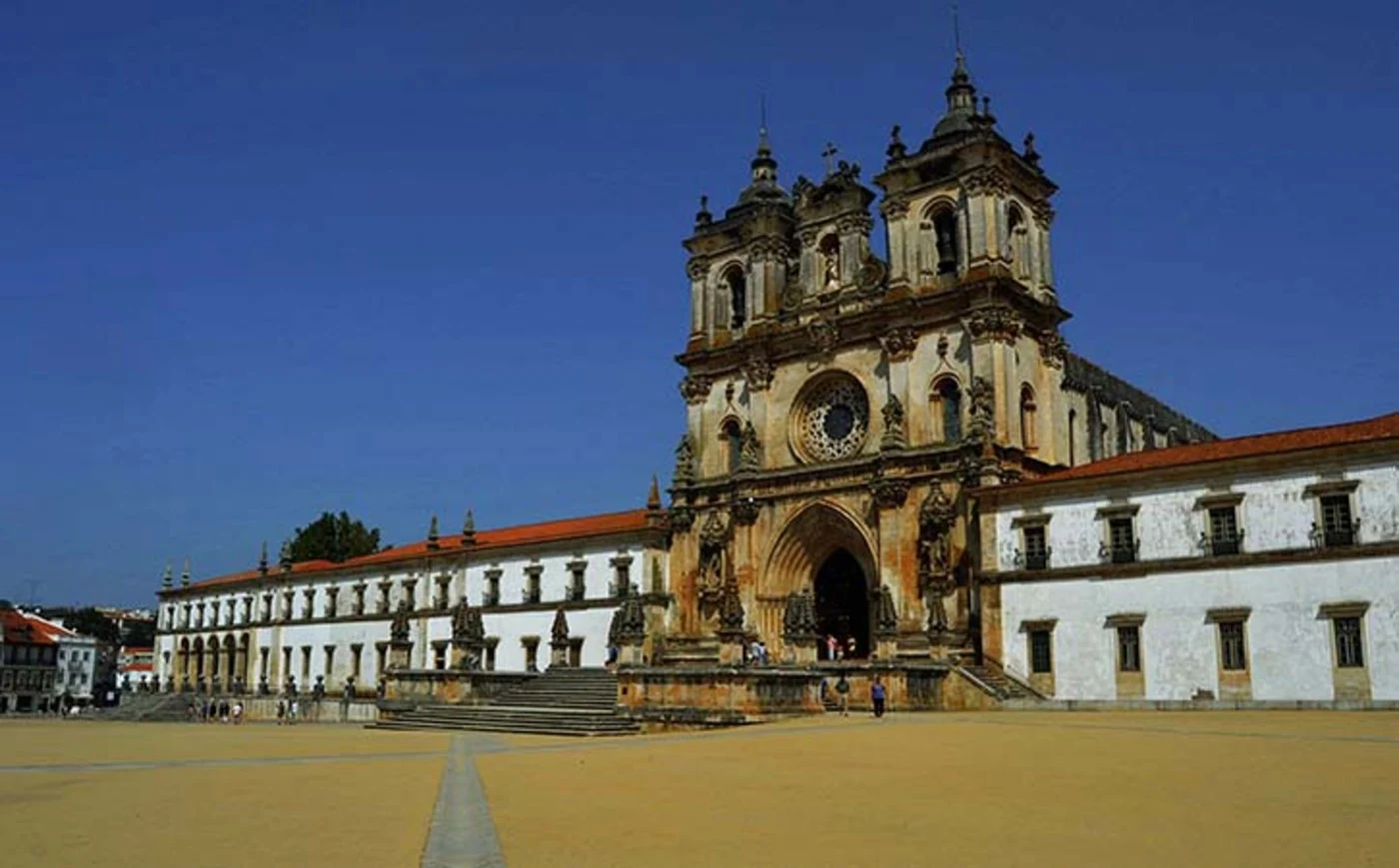
The façade you see from the square is a little misleading. Of the original front, only the Gothic portal has survived intact. Everything else, the bell towers, the statues and the curving top, is the result of the great building works of the 17th and 18th centuries. Above the door, statues of virtues and saints form a composition that announces the Baroque but does not prepare you for what comes next.
Step through the portal and the era changes. The interior is pure Cistercian Gothic: three naves stripped of ornament, with no gilded images or paintings, where all the beauty lies in proportion and light. The church is about 106 metres long, and all three naves rise to exactly the same height, about 22 metres. Because the church is narrow in relation to its length, the effect is an almost dizzying verticality. Eight centuries after it was built, it is still the largest church in Portugal.
It was also the first fully Gothic building in the country. When the church was completed, the new style from France was still a rarity in the Peninsula. Its plan closely follows that of the abbey of Clairvaux, Saint Bernard’s home, with an apse surrounded by an ambulatory opening onto chapels. The monks wanted architecture that helped prayer: no distractions, no colour, only stone, rhythm and light.
Look at the columns. In the central nave, many of them do not reach the floor but stop several metres up, resting on corbels. It was a practical solution that left room for the monks’ choir stalls, but it further heightens the impression that the structure is floating. The windows are clear, almost colourless, as the austerity of the order required, which is why the light inside has that white, even quality that so impresses visitors.
What to look for in the church
- The tombs of King Pedro and Inês, facing each other in the arms of the transept. They are the reason many visitors come to Alcobaça and deserve a long visit in themselves.
- The ambulatory and the apse chapels, where the French roots of the architecture are clearest.
- The Royal Pantheon, where other members of the royal family from the first centuries of the monarchy are buried.
- The Chapel of the Death of Saint Bernard, with a large clay sculpture group showing the last moments of the order’s spiritual founder.
- The light. If you can, go in early in the morning or late in the afternoon, when the low sun crosses the windows and draws the stone.
Pedro and Inês: the story the stones keep
No visit to Alcobaça is complete without the story of King Pedro and Inês de Castro. Pedro was heir to the throne, the son of King Afonso IV. Inês was a Galician noblewoman who came to Portugal in the retinue of Pedro’s wife, Constança. Between the two grew a passion the court never accepted. After Constança’s death, Pedro and Inês lived together and had children, and the influence of the Castro family came to be seen as a threat to the kingdom’s independence and to the succession.
In 1355, Inês was murdered in Coimbra, on the orders or with the consent of King Afonso IV. Pedro rebelled against his father and, when he came to the throne in 1357, pursued those responsible for Inês’s death and declared that he had married her in secret. He commissioned two magnificent tombs and, around 1361, ordered Inês’s body to be moved from Coimbra to Alcobaça in a ceremony the country never forgot. When he died in 1367, he was buried in the tomb he had prepared for himself.
Popular tradition added a famous episode: Pedro is said to have had Inês’s corpse seated on a throne and forced the court to kiss her hand, crowning her after death. Historians consider this a legend, but it helped turn Inês into the queen after death whom poets, playwrights and painters have celebrated ever since, from Camões to the present day.

Two tombs, one masterpiece
The tombs of King Pedro I and Inês de Castro are considered the masterpieces of Portuguese Gothic funerary sculpture. They stand in the two arms of the transept, facing each other. Tradition says they were placed this way so that, on Judgement Day, the two lovers would rise and see each other first. Carved on the tombs is the phrase that sums up this story: “Até ao fim do mundo”, until the end of the world.
King Pedro’s tomb rests on six lions and is crowned by a frieze bearing the shields of Portugal. The sides tell the life of Saint Bartholomew in small carved scenes. At the head is the most famous element of the whole ensemble: the so-called Wheel of Life, a great rose formed by eighteen small niches in two concentric bands, the inner one representing the Wheel of Fortune. Many scholars read in these scenes the story of Pedro and Inês themselves.
Inês’s tomb is just as rich. Her recumbent figure, hands joined and face serene, is surrounded by angels. The foot panel shows the Last Judgement, arranged in three tiers along a wavy line, with the damned being swallowed by the mouth of the monster Leviathan. Take time to look closely: the number of figures, expressions and details is extraordinary, and every visit reveals something you missed before.

The Cloister of King Dinis, the cloister of silence
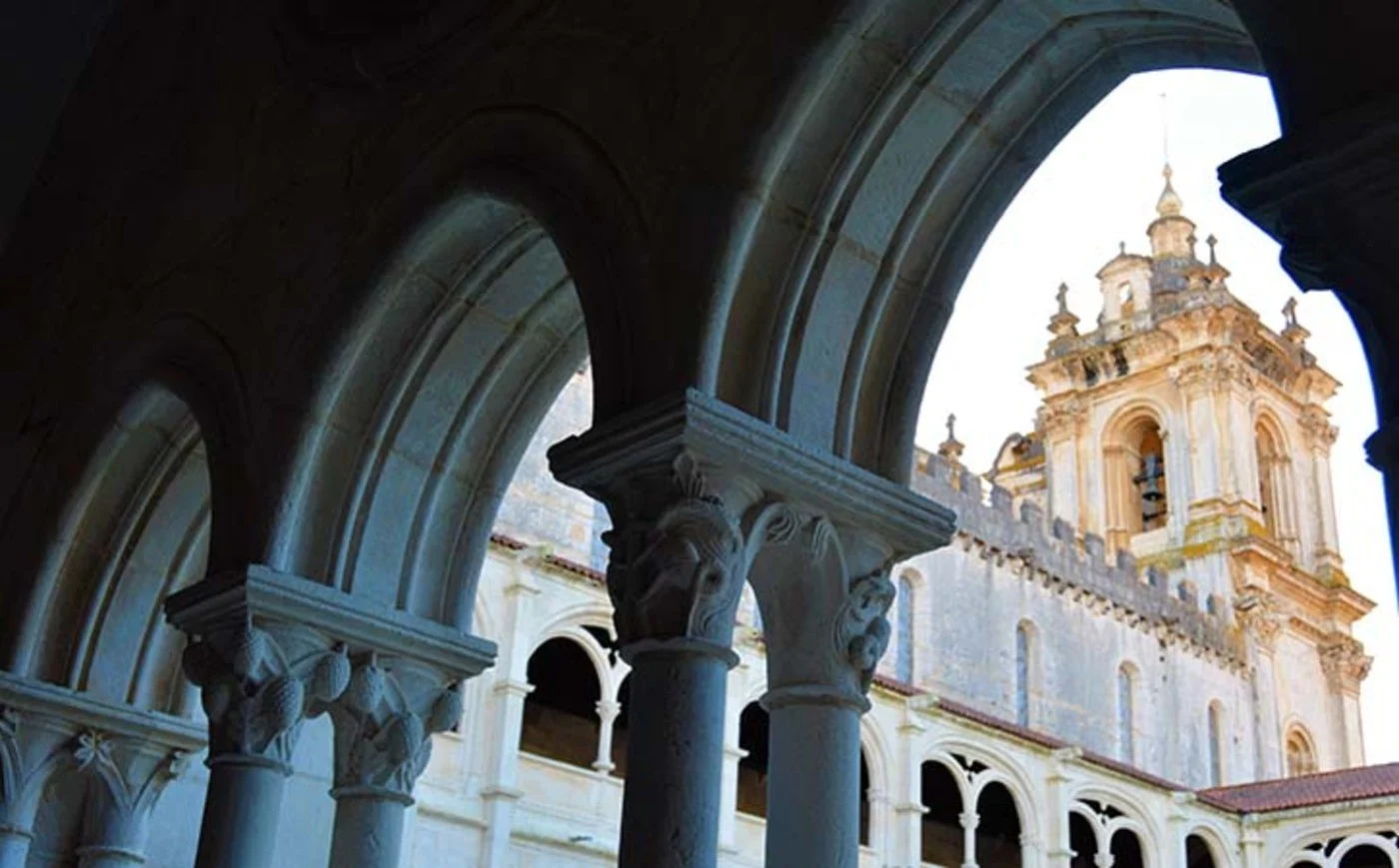
Leaving the church on its north side, you step into the heart of monastic life: the cloister. It is known as the Cloister of King Dinis, because it was this king who ordered it built, and also as the Cloister of Silence, because this was where the monks walked and meditated without exchanging a word. The lower floor dates from the 14th century and is one of the most elegant works of Portuguese Gothic, with grouped arches under large relieving arches and lace-like stone oculi that let the light through.
This cloister was so admired in its day that it became the model for the cloisters of the cathedrals of Coimbra, Lisbon and Évora. The capitals of the columns, decorated with plant motifs, contrast with the sobriety of the church and show how the austerity of the first Cistercian generations gradually gave way to a more decorative taste.
The upper floor was added in the 16th century, during the reign of King Manuel I, and is attributed to the architect João de Castilho, who also worked on the Jerónimos Monastery in Lisbon. The difference in style between the two storeys is easy to see and turns the cloister into an open book on the evolution of Portuguese architecture. In the centre, the garden and the sound of water complete one of the most peaceful places in the whole monastery.
The lavabo
On one side of the cloister, beside the entrance to the refectory, stands the lavabo, a small pavilion where the monks washed their hands before meals. The lavabo you see today is Renaissance, and its fountain is one of the most photographed details of the visit. It was a simple gesture, repeated every day, and it helps you picture the routine of a community that at times numbered many dozens of monks.
The monks’ rooms
What makes Alcobaça unique in the world is not only the church. It is the fact that the whole set of medieval rooms where the monks lived, prayed, worked, ate and slept has survived almost complete. Walking through them, room by room, you understand how a Cistercian abbey actually worked.
Chapter House
Probably built in the mid-13th century, it is one of the most beautiful rooms in the monastery, with a more elaborate vaulting than the other rooms. Here the community met every day to hear a chapter of the Rule of Saint Benedict read aloud, which is where the name comes from. This was also where decisions were taken, faults were confessed and abbots were elected.
Parlour and Monks’ Hall
The parlour was the only place where, under certain circumstances, the monks were allowed to speak to one another. Next to it is the Monks’ Hall, a large workroom which is thought to have housed the famous scriptorium, where monks copied and illuminated manuscripts. Part of Alcobaça’s extraordinary library was produced here.
Dormitory
On the upper floor, reached by a staircase, is the dormitory. It was one of the first rooms to be built and its simplicity speaks for itself: three aisles lit by narrow slit windows, rib vaults resting on columns, and a vast space where the monks slept together. It is one of the most impressive rooms in the monastery, precisely because it contains almost nothing.
Refectory
The refectory is a large vaulted hall where the monks ate in silence while one of them read sacred texts aloud. The reading was done from a pulpit set into the wall and reached by a beautiful arcaded stair. Tradition says that the door into the refectory was deliberately narrow, and that any monk who could not fit through it had to fast. It is a hard story to confirm, but the guides love telling it.

The kitchen: a temple of gluttony
If the church is the most solemn place in Alcobaça, the kitchen is surely the most surprising. The kitchen you visit today was built and lined with white tiles in the mid-18th century, when the abbey was still extremely wealthy. What strikes you as soon as you walk in is the gigantic central chimney, which seems to hover over the room and rests on eight iron columns. It is said that a whole ox could be roasted beneath it.
Even more ingenious is the water system. The monks diverted a branch of the River Alcoa into the kitchen through a channel built for the purpose, and the water ran into a large stone tank. This gave them running water for cooking and washing and, according to tradition, even fresh fish, which arrived alive with the current. In the 18th century, this was a remarkably modern solution.
The fame of Alcobaça’s table spread across Europe. The English traveller and writer William Beckford, who visited the monastery at the end of the 18th century, called its kitchen and refectory the most distinguished temple of gluttony in all Europe. The region’s tradition of convent sweets owes a great deal to this heritage. After the visit, it is worth tasting some of them in the town’s pastry shops.
The Hall of the Kings
For many visitors, the Hall of the Kings is the first room of the visit, and today it serves as the monastery’s reception and shop. Its name comes from the statues of the kings of Portugal, made in the 17th and 18th centuries, which stand in niches along the walls. Below them, 18th-century tile panels tell the story of the monastery’s foundation, including the gift of the lands to Saint Bernard and the promise made by King Afonso Henriques before the capture of Santarém.
It is worth reading the tiles carefully before entering the cloister. In true Baroque fashion, they sum up the account the monks wanted to leave of their own origins, and they help you make sense of the rest of the visit. The monastery also keeps pieces of religious sculpture of great delicacy, such as this image of the Virgin and Child.

Other rooms not to miss
- Hall of Tombs: next to the church, it holds the tombs of members of the royal family from the first centuries of the monarchy. It is considered the first neo-Gothic work in Portugal.
- Chapel of the Death of Saint Bernard: a large clay sculpture group showing the saint’s death, surrounded by monks and angels.
- Manueline sacristy: its portal is one of the finest examples of Manueline decoration in the monastery.
- Cardinal’s Cloister and Rachadoiro Cloister: built between the 16th and 18th centuries, they show how the monastery expanded in the early modern period. They are not always open to the public.

A day in the life of an Alcobaça monk
To understand the monastery, it helps to imagine the rhythm of the people who lived here. The Cistercians followed the Rule of Saint Benedict, often summed up in two Latin words: ora et labora, pray and work. The day began long before sunrise with the first office of prayer in the church, and was punctuated by seven moments of communal prayer, from Matins to Compline. In between came reading, manual work, study and meals, always taken in silence.
The Cistercians stood apart from other orders through their simplicity. Saint Bernard criticised monasteries full of gold, sculpture and painting, which he believed distracted monks from prayer. That is why the church at Alcobaça is so bare, and why the building’s beauty lies entirely in proportion, in the quality of the stone and in the light. This early austerity softened over the centuries, as the cloister capitals, the royal tombs and the Baroque façade show, but the spirit of the beginnings can still be felt in the medieval rooms.
Manual work was central. The monks and the lay brothers, laymen who lived in the community and mainly took care of farm work, transformed the landscape of the Alcobaça lands. They drained marshland, opened up fields, planted orchards and vineyards and organised a network of granges that supplied the abbey. Much of the region’s fruit-growing tradition, still famous today for its apples and pears, is heir to these centuries of work.
At the same time, the monastery was a centre of learning. In the Monks’ Hall and the scriptorium, manuscripts were copied and illuminated, and Alcobaça’s library became one of the richest in the kingdom. The school opened in 1269 is a sign of this cultural role, which made the abbey a point of reference far beyond its own walls.
A living monastery: music, fairs and celebrations
Alcobaça Monastery is not only a monument to look at. Throughout the year it hosts concerts, talks, fairs and other events that bring its rooms back to life. The highlight is the Cistermúsica music festival, which brings concerts to the monastery and to other venues around town. Hearing music inside these walls, with the acoustics of the stone, is an experience you will not forget.
To find out what is on during your stay, see our page on annual events in Alcobaça and the monastery’s official programme. On event days, some rooms may be closed to the public while things are set up, so it is worth checking beforehand.
Visiting with children
The monastery can be a good family visit, as long as you choose the right stories. The kitchen, with its giant chimney and river water running through it, is usually the children’s favourite room. The story of Pedro and Inês, suitably adapted, and a hunt for animals and figures on the tombs turn the church into an observation game. Bring water and a snack for after the visit, and expect stairs on the way up to the dormitory.
Photographing the monastery
The best photographs of the façade are taken from the square, early in the morning or late in the afternoon, when the side light brings out the sculptures and the stone takes on golden tones. Inside the church, make the most of the natural light and do not use flash. In the cloister, the arches of the lower floor frame the garden and the towers and give some of the most beautiful images of the visit. For a view of the whole complex, climb to one of the high points of the town and see how the monastery dominates the rooftops of Alcobaça.
How to visit Alcobaça Monastery
The monastery stands in the centre of Alcobaça, on Praça 25 de Abril, and you cannot miss it. The visit has two parts. The church is free to enter during opening hours, and this is where the tombs of Pedro and Inês are. The monastic rooms, with the cloister, the chapter house, the dormitory, the refectory, the kitchen and the Hall of the Kings, are part of the paid circuit.
Opening hours and closures
From 1 November to 31 March, the monastery is open from 9am to 5:30pm, with last entry at 5pm. From 1 April to 31 October, it is open from 9am to 6:30pm, with last entry at 6pm. It is closed on 1 January, Easter Sunday, 1 May, 20 August and 25 December. Hours and prices may change, so always check the monastery’s official website before setting out.
A suggested route
- Start in the church, with time for the nave, the ambulatory and the tombs of Pedro and Inês.
- Enter the paid circuit through the Hall of the Kings and read the foundation tiles.
- Walk all the way round the Cloister of King Dinis, on both floors.
- Visit the Chapter House, the parlour and the Monks’ Hall.
- Climb up to the dormitory.
- Finish in the refectory and the kitchen, stopping at the lavabo on the way.
Tips to make the most of it
- Go early. Just after opening there are fewer groups, more silence and lovely light in the church.
- Avoid the busiest hours in summer, especially in July and August, when the coach tours arrive.
- Bring a jacket. Even in summer, the stone interior is cool.
- Take photos without flash and respect services in the church.
- Visit with a guide if you want to understand the tombs in detail. There are so many carved scenes that an explanation makes all the difference.
Recommended guided tour
Alcobaça Monastery: Private Guided Tour
A private visit with a local guide, to understand the tombs of Pedro and Inês, the cloister and the kitchen in detail.
Getting there
Alcobaça is in the district of Leiria, just over an hour’s drive from Lisbon on the A8 motorway. From Nazaré, São Martinho do Porto or Batalha it is only a few kilometres by road. There is public parking around the historic centre, a short walk from the monastery. If you are travelling by public transport, there are bus connections from Lisbon and other towns in the region.
Combining it with Batalha and Tomar
Alcobaça is part of a trio of World Heritage monuments that lie close to one another: Batalha Monastery, about half an hour away by car, and the Convent of Christ in Tomar. Visiting all three in one or two days is one of the best ways to understand the history of Portugal, from the birth of the kingdom to the Age of Discovery. If you would rather someone else took care of everything, there are private tours that combine Alcobaça and Batalha in a single day.
Even closer, just a few kilometres from the centre, is the Monastery of Santa Maria de Cós, a former convent for nuns linked to the same order. Its church, with a painted wooden ceiling and paintings attributed to Josefa de Óbidos, is a real discovery for anyone who already knows Alcobaça and wants to see another side of the region’s Cistercian heritage. And if your trip continues to the coast, Nazaré and the bay of São Martinho do Porto are less than half an hour’s drive away, perfect for ending the day by the sea.
To see both monasteries
Alcobaça and Batalha Monasteries: Private Guided Tour
Two World Heritage monasteries in one day, with transport and a private guide.
Where to eat
The square in front of the monastery and the surrounding streets have restaurants, cafés and pastry shops where you can try the regional cooking and the convent sweets. Rather than leaving a list here that could go out of date, we have gathered the practical information about the town in our Essential Alcobaça guide. If you have time, keep an afternoon free for a ceramics workshop, another of the region’s traditions, which can be combined with a visit to the monastery.

Frequently asked questions
How much does it cost to visit Alcobaça Monastery?
The standard ticket costs €15 and gives access to the circuit of the monastic rooms. Portuguese citizens and residents of Portugal get in free for up to 52 days a year under the Acesso 52 scheme: just show your Portuguese Citizen Card at the ticket office (foreign residents show an ID document and their Portuguese tax number, NIF). The church, where the tombs of King Pedro and Inês de Castro lie, is free to enter during opening hours.
What are the opening hours of Alcobaça Monastery?
From 1 November to 31 March, 9am to 5:30pm, with last entry at 5pm. From 1 April to 31 October, 9am to 6:30pm, with last entry at 6pm.
When is Alcobaça Monastery closed?
It is closed on 1 January, Easter Sunday, 1 May, 20 August and 25 December.
How long does the visit take?
An unhurried visit to the church and the monastic rooms takes between an hour and a half and two hours. With a guide, or if you are very interested in the tombs, allow more time.
Where are Pedro and Inês buried?
In the church of Alcobaça Monastery, in two Gothic tombs placed facing each other in the arms of the transept. The tombs are considered masterpieces of Portuguese funerary sculpture.
Why is Alcobaça Monastery a World Heritage Site?
UNESCO listed it in 1989 as a masterpiece of Cistercian Gothic art, for the scale of its dimensions, the purity of its style, the beauty of its materials and the care of its construction, and because it preserves a unique set of medieval monastic rooms.
Who founded Alcobaça Monastery?
The monastery was born from the gift of the lands of Alcobaça by King Afonso Henriques, the first king of Portugal, to Bernard of Clairvaux and the Cistercian Order. The founding charter is dated 8 April 1153 and construction of the abbey began in 1178.
Is it worth visiting the monastery with a guide?
Yes, especially if you want to understand the tombs of Pedro and Inês and the life of the monks. A guide helps you read the carved scenes and connect each room to the history of the abbey.
More about Alcobaça
- Alcobaça Monastery: hours, tickets and location
- Alcobaça Monastery: private guided tour
- Monastery tour and ceramics workshop
- Religious heritage of Alcobaça
- Monastery of Santa Maria de Cós
- Museums and galleries in Alcobaça
- Annual events in Alcobaça
- Essential Alcobaça
This guide was prepared by the GoAlcobaça team, the tourist guide to Alcobaça. Hours and prices checked in November 2026: always confirm with the monastery before your visit.